
Abstract
This paper analyzes the legal dimensions and regulatory framework of e-VTOL aircraft, providing a comprehensive review of the modifications and adaptations of legislation, while emphasizing the current status and integration issues within urban air transportation systems. Primary focal points encompass the progress, execution, and challenges of regulations established by the FAA, EASA, and state authorities concerning electric vertical takeoff and landing (e-VTOL) aircraft, which are critical for urban air mobility operations in metropolitan setting. These advancements must be incorporated into the urban regulatory framework, encompassing current aviation regulations and the imperative to establish new policies tailored for urban aerial transportation. This study delineates a framework and an extensive overview of regulations for diverse stakeholders, including the aviation sector, policymakers, and urban planners, emphasizing the necessity for a profound comprehension of regulations and the potential of UAM for effective integration into urban mobility systems.
Keywords
- Regulation
- Legal Framework
- e-VTOL
- Urban Air Mobility
1. Introduction
Advanced Air Mobility (AAM) refers to a new concept of air transportation that represents a transformative change in the aerospace industry, enabling new capabilities and applications. AAM systems incorporate next-generation transport, including remotely piloted, autonomous, or vertical takeoff and landing (VTOL) aircraft powered by electric or hybrid-electric propulsion. An electric vertical takeoff and landing (eVTOL) aircraft is designed to move people and cargo between places not easily served by surface transportation or existing aviation modes. AAM is poised to significantly impact Urban Air Mobility (UAM) by leveraging Enhanced Accessibility and Reduced Travel Time, with Environmental Benefits and Economic Growth, as well as ensuring Safety and Security of air travellers following to airworthiness requirements (Arco et al., 2023). Electric vertical take-off and landing (e-VTOL) aircraft, as a swiftly flowing technology at the intersection of innovation, sustainability, and changing transportation requirements, are set to transform the aviation sector. This novel lightweight aircraft uses electric power for vertical take-off, hovering, and landing and has become essential in meeting contemporary urban transportation demands. eVTOLs provide an eco-friendly transportation alternative for transporting passengers and freight in metropolitan environments up to 500 km, mitigating ground transit congestion and decreasing carbon emissions. Commercial e-VTOL operations startups Joby and Archer Aviation are expected to commence air taxi networks in 2025 (Bellan, 2024). Although e-VTOL technology has been conceptualized for over a decade, advancements and investments in the area have markedly intensified in recent years. Progress in electric battery technology and an increasing desire for sustainable transportation have stimulated interest in e-VTOLs across several sectors, including aviation, automotive firms, technological start-ups, and earlystage investors. The augmented prospects in e-VTOLs are integral to the transportation sector’s emphasis on advanced air mobility, which seeks to modernize and optimize the conveyance of individuals and goods within regional and urban networks. Within AAM, e-VTOLs are anticipated to be pivotal in urban air mobility, the developing paradigm for air transportation at reduced altitudes within and between metropolitan areas. The eVTOL business is evolving swiftly, with numerous companies engaging in collaborative ventures for innovative e-VTOL designs and infrastructure, such as fleet operation, vertiports, air traffic management, and maintenance in pursuit of commercial applications. Numerous e-VTOL classifications exist, each with distinct design architectures, battery power concepts, and flight performance options (VFS, 2024). EASA (2019) has evaluated around 150 distinct e-VTOLs to facilitate equitable certification for various urban air vehicles, as outlined in document SC-VTOL-01. Thus, the differentiation of e-VTOL projects offers a competitive edge in market accessibility, while also presenting several disadvantages related to maintenance, operational costs, and expenditures. The maintenance organization and associated processes in the aviation sector are founded on a series of procedures derived from legislation and management decisions established by common international regulations, including the International Civil Aviation Organization (ICAO), European Union Aviation Safety Agency (EASA), Federal Aviation Administration (FAA) of the United States, and local civil aviation authorities (CAA). Conventional aircraft maintenance depends on manufacturer maintenance planning documents (MPD) sanctioned by the aviation authorities of the operating countries. The maintenance program (MP) encompasses four distinct types of checks (A, B, C, and D) categorized as line and base maintenance (Sriram and Haghani, 2003), along with the execution of changes, alterations, and AD/SB in accordance with manufacturer directives. All inspections concentrated on evaluating aircraft systems and essential components based on flight hours and cycles, occasionally employing calendar intervals (Bugaj et al., 2019; Sanchez et al., 2020). In the implementation of urban air mobility (UAM) operations, it is essential to adopt a maintenance and engineering strategy that schedules repair activities based on aircraft usage and demand projections. Maintenance, Repair, Overhaul (MRO) is a crucial infrastructure in the aviation industry, serving as an organization that guarantees operational safety and upholds the reliability of urban air vehicles through a manufacturer-mandated maintenance program (Liu et al., 2019). The designated maintenance servicing team at vertiport line stations will conduct pre-flight checks, visual inspections, battery charging for air vehicles, and minor airframe and avionics system assessments for release to service (CRS), all while adhering to the flight schedule and facilitating operational efficiency. As air mobility matures, base maintenance inspections must be conducted on a substantial fleet of aircraft at authorized MRO facilities for specific vehicle types. The aviation sector is experiencing a shortage of technical personnel, and the introduction of e-VTOL aircraft is anticipated to exacerbate the issue. As the UAM market evolves, aviation will transform, necessitating the adaptation of certification for maintenance workers specializing in advanced air mobility (AAM) aircraft types, including avionicselectrical and aircraft powerplant technicians/mechanics, as well as aircraft maintenance engineers. Prior to the acquisition of type certification for e-VTOL aircraft, the maintenance framework and MRO activities were undefined (Noble, 2023); nevertheless, the requisite skills and prevailing regulations for maintenance procedures will align with Part-145, as established by either the FAA or EASA (Roger, 2023). The present research is proposing a future-oriented MRO framework compliant with Part145 regulations for maintenance activities with e-VTOL aircraft. Final regulations for the introduction of Innovative Air Mobility (IAM), which includes air taxi services, have been established by the European Commission through the adoption of a set of secondary laws pertaining to drones and VTOL capable aircraft. This package is based on the EASA’s (European Aviation Safety Agency) legislative suggestions, which were released in August 2023 in Opinion No. 03/2023. All areas of Air Operations (Air OPS), Flight Crew Licensing (FCL), Standardized European Rules of the Air (SERA), and Air Traffic Management (ATM) are covered by the new regulations that govern piloted electric air taxis. Additionally, it lays out procedures and standards for the certification and upkeep of unmanned aerial vehicles. With this package and other pieces of legislation already in place, air taxi services can finally take off. Additionally, in order for air taxis to start operating in Europe, certification from the European Aviation Safety Agency (EASA, 2024) is necessary. Additionally, technological integration, including automation and artificial intelligence, is shaping the current state of VTOL. These systems enhance operational efficiency, enabling greater reliability and safety. As these technologies improve, it looks like VTOL aircraft could become popular very quickly. This would make them a vital part of modern aviation. The significance of electric aircraft with Vertical Take-Off and Landing capabilities can take off and land in urban areas without the need for runways, making air transportation more accessible and reducing congestion on traditional ground routes. It drastically cut travel times within cities by providing direct routes and avoiding ground traffic, which is especially beneficial for emergency services and cargo delivery. Electric propulsion systems, designed in many e-VTOL aircraft, reduce emissions and contribute to a cleaner urban environment. The development and deployment of VTOL aircraft can create new job opportunities in manufacturing, maintenance, and air traffic management, boosting local economies. The study aims to facilitate the integration of e-VTOL technologies into urban air transportation systems by adapting to upcoming regulations, making urban air mobility a viable and sustainable option for the future. The study addresses gaps in current regulatory frameworks by providing a comprehensive review of the existing regulations and identifying specific areas where modifications are needed to support the safe and efficient operation of e-VTOL (electric Vertical Takeoff and Landing) aircraft in urban environments. By addressing these areas, the study it proposes tailored policies that focus on: Safety and Airworthiness Standards, Noise Levels, Collaborative Efforts, and Public Acceptance Section 2 provides a Method which, overviews of the regulatory framework for the air transportation system; introduces the development of e-VTOL flying machines and the integrated mobility ecosystem; describes the technological changes affecting regulatory landscape uncertainty; outlines the advancement and implementation of regulation policy for e-VTOL air vehicles at an acceptable level issued by FAA and EASA; deals with the issued regulations, filling a gap in the literature, adding a legal framework status applicable for e-VTOL aircraft and giving the basis for a future pathway, Section 3 contains Result and Discussion, the Section 4 is includes Conclusion.
1.1 Development of e-VTOL flying machines by integrated mobility ecosystem
At the onset of the 21st century, a paradigm change transpired as traditional helicopters progressively yielded to e-VTOL flying machines, with developments accelerating in the ensuing decades. e-VTOLs exhibit considerable variation in speed, altitude, flight range, and passenger capacity, primarily offering diminished noise, reduced operational expenses, and improved safety (Al-Rubaye et al., 2023). Currently, international corporations including as Wisk, Archer, and Joby Aviation in the United States, Lilium, Airbus City, and Volocopter in Europe, along with EHang in China, are spearheading a new era in urban air mobility initiatives (Figure 1). In the pursuit of sustainable and efficient transportation options, e-VTOLs are leading the charge in Urban Air Mobility (UAM). The rapid development of eVTOLs, designed to revolutionize air transportation as air taxis, leisure and emergency response vehicles, while improving freight transport capacity, is driven by advancements in battery technology, electric motors, and autopilot systems (Yan et al., 2023).
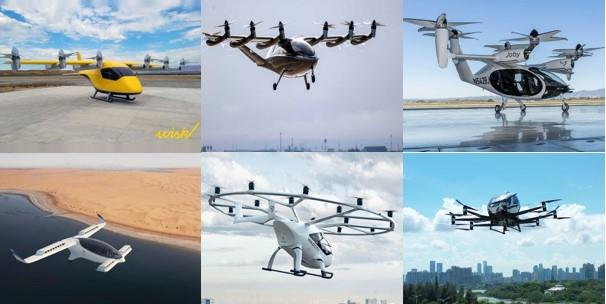
Fig. 1. e-VTOL air vehicle types
A crucial indicator of the e-VTOL business is the investment in diverse aircraft prototypes, particularly over the past five years. The terminology of UAM and ondemand mobility was presented during the inaugural meeting held in 2016 arranged by the Uber company, which redefined and envisioned urban air transportation network concept (Holden and Goel, 2016). The NASA concept “UAM maturity levels” outlines the progression of Urban Air Mobility through six phases, in which each step is dedicated to solving specific challenges concerning aerospace integration, social acceptance, and air vehicle technology development. These concepts outline a framework for the dynamic development of Urban Air Mobility (UAM) in the biggest metropolises (Goodrich and Theodore, 2021). Meanwhile, developers of urban air transportation networks such as Uber, Blade, and Airbus, being beginners-pioneers in airborne ride-sharing in charter services, demonstrated utilizing modern e-VTOL technologies and innovative business models in Sao Paulo and New York (Haynes and Alerigi, 2016; Uber, 2019) megapolises. Many groups and companies are working on e-VTOL airplanes, a relatively new concept in the field of air mobility vehicle design. Compared to regular planes and helicopters, the new design architecture of these air vehicles is more efficient and faster, while ensuring flight safety. They utilize advanced materials, autonomous technology, and are equipped with batteries and electric propulsion systems, providing a new degree of urban mobility and allowing to change the way people travel in the future. Particularly for short- to medium-distance transit within future urban mobility, the air vehicles will be the best solution to provide efficient and fast movements. In terms of vehicle types, the most common ones are following (Partheepan et al., 2023) Electric multicopters – Are small unmanned aerial vehicles (UAVs) with several propeller blades that run on electricity. The ability to take off and land vertically is an advantage and suitable to use in restricted spaces. Their typical range is about 50 km, and payload is accounted to take on board nearly 100 kg of cargo. Hybrid Tiltrotors – Air vehicles can go horizontal and vertical with the use of a mix of fixed wings and tiltable rotors. They are capable of carrying larger payloads of up to 1000 kg and can travel longer distances consisting of about 400 km (Dinc, 2020). Electric fixed-wing e-VTOLs have the capability to get their lift from electric motors rather than propellers. With a range of about 100 kilometers, they require a runway for take-off and landing. They can handle loads as heavy as 500 kg. Unlike electric multicopters, hydrogen fuel-cell multicopters don’t rely on batteries for propulsion but instead use hydrogen fuel cells. They are capable of carrying weights as heavy as 150 kg and have a range of up to 200 km. Gasoline-powered fixedwing e-VTOLs are prototypes of the electric fixed-wing type; however, the power source is gasoline instead of electricity. The payloads are close to one ton and reach greater ranges of 500 km. The most common different aircraft type classifications of e-VTOL aircraft from the AAM/UAM family are wingless/multicopter, lift and cruise, and vectored thrust with particular advantages and disadvantages (EASA, 2021), (Figure 2). Vectored thrust is able to gain the highest speed, enhanced maneuverability, improved performance, and reduced runway requirements; however, it has an increased weight, complexity, high maintenance cost, and limited range (Afridi et al., 2023). Lift+Cruise air vehicles are developed to separate the functions of vertical lift and forward cruise. The key features are simplified design, which can reduce the complexity of transitioning between vertical and horizontal flight, and operational flexibility, the ability to operate propulsion units independently or in combination, ensuring versatile performance during lift, hover, and forward cruise. Increased weight and complexity, higher energy consumption, as well as limited range and speed, could potentially impact overall efficiency, which is a critical factor for electric vehicles (Memon,2023). Wingless multicopters, referred to as multirotor air vehicles, are simple in control, able to perform complex aerial manoeuvres, can hover in place, and fly in any direction, and vice versa having shorter flight duration, lowest payload, and speed limitation (EASA, 2023a; Quan et al., 2020).
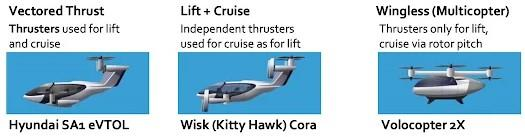
Fig. 2. e-VTOL type classification (EASA, 2021)
Furthermore, it is crucial to take into account the entire ecosystem of e-VTOL aircraft fields to ensure UAM operation. This ecosystem includes services such as fleet operations and physical infrastructure, which includes passenger hubs, terminals, vertiports, take-offs, and landing pads. The management of digital infrastructure improves safety and efficiency by using a control center for air traffic management (ATM), air traffic control (ATC), and communication-navigation-surveillance (CNS). The 5G network also has navigation aids built in. MRO services ensure the airworthiness of e-VTOL vehicles by performing maintenance, repair, and overhaul (MRO) tasks on demand and at scheduled service intervals. The physical infrastructure also includes the necessity of performing maintenance in hangar facilities, (Roland Berger, 2020). Frost and Sullivan indicates that because to robust governmental support and continuous pilot initiatives, the United Arab Emirates (UAE), New Zealand, and Singapore are anticipated to be early adopters of Urban Air Mobility (UAM) systems. Dubai is poised to become the first city worldwide to commercialize air taxis. To initiate these services within the next two years, businesses like as Volocopter and EHang, in partnership with the UAE’s Roads and Transport Authority (RTA), have conducted extensive trials. New Zealand’s commitment to the future of mobility is apparent; since 2017, Kitty Hawk (Cora) has executed around 1000 test flights in the Canterbury region. Singapore is poised to benefit from a first mover advantage. Volocopter is collaborating with various government organizations to evaluate the viability of launching commercial air taxi services in the city-state. Brazil and Mexico are also poised to be early adopters, intending to utilize their proficiency in helicopter taxis. Simultaneously, the United States has served as the epicentre of Urban Air Mobility (UAM) development, with over 70% of market stakeholders located within its borders (Vijayakumar, 2019).
2. Method
2.1 Overview of the regulatory framework for air
transportation system
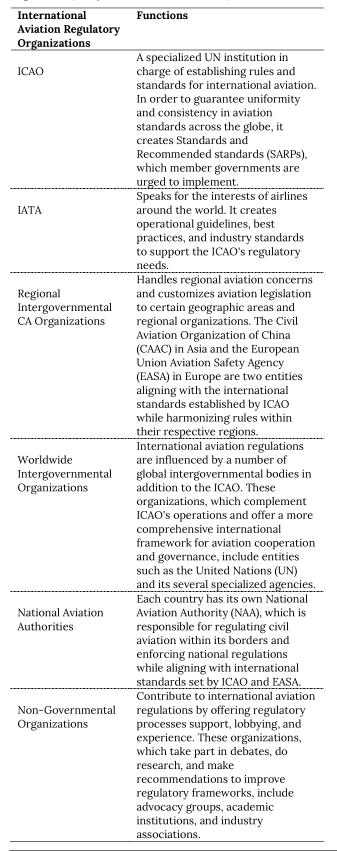
A comprehensive framework of aviation regulations has been instituted to facilitate the orderly conduct of air travel, examining the principal elements of international aviation regulations and emphasizing the functions of significant entities such as the International Civil Aviation Organization (ICAO), the Federal Aviation Administration (FAA), the European Aviation Safety Agency, the International Air Transport Association (IATA), and National Civil Aviation Organizations (NCAO). International aviation regulations are laws and standards developed to regulate several facets of worldwide air transport. These standards guarantee the safety, security, and efficiency of international flights, covering a comprehensive array of operational, technical, and legal stipulations. International entities such as the International Civil Aviation Organization (ICAO), founded under the Chicago Convention of 1944, principally formulate and implement these regulations. The International Civil Aviation Organization (ICAO) advocates for member governments to implement its Standards and Recommended Practices (SARPs) to enhance uniformity and consistency in global aviation safety and operations. International aviation regulations encompass various domains, including aircraft operations, airworthiness, airport infrastructure, pilot certification, air traffic management, and environmental safeguarding. International aviation regulations seek to mitigate risks, prevent accidents, and facilitate uninterrupted air transport across national borders. These regulations also encompass matters such as passenger rights, liability in the event of accidents or incidents, and the legal framework governing international air services agreements between nations. Airlines, airports, and aviation staff must comply with these requirements to uphold uniform safety and security standards. The commencement and proposal process generally commences with the identification of areas for regulation or the revision of existing standards. This could be prompted by technological improvements, safety accidents, environmental concerns, or alterations in global air traffic patterns. Member nations, international entities like the International Civil Aviation Organization (ICAO), or industry stakeholders advocate for new legislation or modifications. The structure of International Aviation Regulations involves a network of organizations and bodies of aviation stakeholders that collaborate to set up and develop standards for safe and effective worldwide air transportation (AnAviationServices, 2024). Different national interests and agendas make it difficult to harmonize international aviation legislation; therefore, nations, international organizations, and industry players must continue to work together to promote a unified regulatory framework. New developments in aviation technology, such as electric airplanes and unmanned aerial vehicles (e-VTOLs, drones), have posed regulatory issues, and the current situation requires the responsible authorities to modify current laws to take these advances into account while maintaining operational integrity and safety.
A comprehensive framework of aviation regulations has been instituted to facilitate the orderly conduct of air travel, examining the principal elements of international aviation regulations and emphasizing the functions of significant entities such as the International Civil Aviation Organization (ICAO), the Federal Aviation Administration (FAA), the European Aviation Safety Agency, the International Air Transport Association (IATA), and National Civil Aviation Organizations (NCAO). International aviation regulations are laws and standards developed to regulate several facets of worldwide air transport. These standards guarantee the safety, security, and efficiency of international flights, covering a comprehensive array of operational, technical, and legal stipulations. International entities such as the International Civil Aviation Organization (ICAO), founded under the Chicago Convention of 1944, principally formulate and implement these regulations. The International Civil Aviation Organization (ICAO) advocates for member governments to implement its Standards and Recommended Practices (SARPs) to enhance uniformity and consistency in global aviation safety and operations. International aviation regulations encompass various domains, including aircraft operations, airworthiness, airport infrastructure, pilot certification, air traffic management, and environmental safeguarding. International aviation regulations seek to mitigate risks, prevent accidents, and facilitate uninterrupted air transport across national borders. These regulations also encompass matters such as passenger rights, liability in the event of accidents or incidents, and the legal framework governing international air services agreements between nations. Airlines, airports, and aviation staff must comply with these requirements to uphold uniform safety and security standards. The commencement and proposal process generally commences with the identification of areas for regulation or the revision of existing standards. This could be prompted by technological improvements, safety accidents, environmental concerns, or alterations in global air traffic patterns. Member nations, international entities like the International Civil Aviation Organization (ICAO), or industry stakeholders advocate for new legislation or modifications. The structure of International Aviation Regulations involves a network of organizations and bodies of aviation stakeholders that collaborate to set up and develop standards for safe and effective worldwide air transportation (AnAviationServices, 2024). Different national interests and agendas make it difficult to harmonize international aviation legislation; therefore, nations, international organizations, and industry players must continue to work together to promote a unified regulatory framework. New developments in aviation technology, such as electric airplanes and unmanned aerial vehicles (e-VTOLs, drones), have posed regulatory issues, and the current situation requires the responsible authorities to modify current laws to take these advances into account while maintaining operational integrity and safety.
Table 1. The structure of international aviation
regulation (Adopted from Anaero, 2024)
The regulatory landscape concerning e-VTOL technology is rapidly evolving; regulatory bodies like the Federal Aviation Administration (FAA) and the European Union Aviation Safety Agency (EASA) are drafting frameworks to ensure safe operation and integration into existing airspace by adapting to the needs presented by these novel aircraft. Thus, changes to the regulatory framework for VTOL aircraft are essential in ensuring safety and efficiency. The new regulatory framework includes several key components, mainly consisting of airworthiness certification as a foundational aspect. In this context, the FAA and EASA are actively continuing to develop standards that specifically address the intricacies of VTOL operations. These standards encompass performance metrics, design criteria, and operational limits. In addition to airworthiness, pilot certification, and training requirements, they are also evolving. The introduction of electric and hybrid-electric VTOL aircraft necessitates new training protocols for pilots.
2.2 Technological change and regulatory landscape uncertainty
Regulatory challenges characterized by increased technological convergence associated with e-VTOL operation require the rapid development and fit-for- purpose regulatory frameworks. In this context, recent published research articles examine a number of regulatory challenges associated with unmanned developments (Du and Heldeweg, 2018). Advances in engineering, manufacturing, and innovative technological change are accelerating the pace of development, resulting in a fundamental level of regulatory uncertainty. These developments include sophisticated simulation models. Novel software tools and Information and Communication Technologies (ICT) such as artificial intelligence, wireless 5G communication, and the miniaturization of electronics create opportunities for e-VTOLs to expand into the civil aviation sector with new use cases. A concomitant challenge of rapid innovation is regulatory uncertainty; moreover, it may result in expanding the uncertainty level and render regulatory action even more challenging (Du and Heldeweg, 2018). The current regulatory frameworks primarily concentrate on preventive measures, which aim to reduce safety risks by adhering to established procedures and manuals. Nevertheless, advancements in battery technologies, electric motors, and the incorporation of cameras, sensors, and navigation systems in new aerial vehicles introduce supplementary hazards and challenges, requiring specialized regulatory frameworks (Finn and Donovan, 2016; Pagallo and Bassi, 2020). Many national authorities are uncertain if current legislative frameworks facilitate the civil aviation sector’s utilization of advanced AI-enabled drones in the future. Civil aviation authorities (CAA) serve as the primary regulatory and administrative entities engaged in the regulatory process under the existing framework. The existing breadth of the CAA’s mandate constrains their capacity to handle pertinent issues. However, other CAAs suggest that the solution may lie not in broadening their scope, but in enhancing collaboration among pertinent producers, governmental bodies, and regulators to foster a conducive atmosphere for the swift advancement of the UAM industry. Numerous current legal systems may lack the capacity to address the difficulties posed by commercial e-VTOLs (World Economic Forum, 2019). Furthermore, there are potentially overlapping regulatory responsibilities between national regulations and local authority rules in the case of urban air mobility upon applying e-VTOL operations. Despite the FAA and EASA having issued numerous regulatory amendments and annexes to existing regulatory acts, there are still challenges that need to be solved to provide success in integration into air transport networking. These rules cover the licensing of maintenance personnel and pilots, air vehicles, vertiports, air traffic management systems, and pertinent infrastructure that is under the regulations of aviation authorities. The requirements for each of these elements vary based on factors such as aircraft mass and performance, flight altitude, use cases, various licensing procedure levels, and the incorporation of regulatory methodologies into the legal systems (Jones, 2017). Furthermore, the technological standards for motor vehicles and conventional aircraft are distinct with broad and diversiform characteristics. According to Yan et al. (2023), Chinese transport authorities have defined 117 mandatory national standards for motor vehicles, while traditional commercial aircraft are subject to 18 only; in addition, there are 622 industrial, and 178 technical, standards, as well as 49 specialized criteria exclusions established for aviation. Reconciling the standards is a serious challenge due to their different objectives and the technological setting achieved since their inception. The proliferated use of flying cars presents potential criminal issues, including hijacking. A perpetrator who seizes control of an aerial vehicle may face repercussions for both aviation and automotive hijacking, potentially leading to legal conflicts. Close relations with current policy support and legal interpretations are insufficient power to resolve these challenges. It is imperative to expedite the amendment and enactment of legislation pertaining to small flying machines and to integrate explicit legal annexes within applicable regulations and laws. This strategy will address the legislative discrepancies and disputes in their implementation. Furthermore, implementing a specialized compliance plan for flying cars throughout the airworthiness certification process can reduce risks and promote further growth. This strategy, a specialist compliance management system, will aid firms in traversing intricate regulatory frameworks, guaranteeing that flying automobiles are both secure and compliant (Yan et al., 2023).
2.3 Advancement and implementation of regulation policy for e-VTOL air vehicles at an acceptable level
The rapid progress in technology and the increasing global need for sustainable transportation have resulted in significant growth in e-VTOLs; however, regulatory and other obstacles must be addressed before these aircraft can be deployed in large-scale commercial operations. Regulations will and should embrace a comparably risk-averse strategy, how this may be addressed and ascertained, and what ramifications it may have for the sector’s development (ITF, 2021). The Department of Transport (DOT), FAA, EASA, and Civil Aviation Authorities (CAAs) in various jurisdictions must persist in advancing and refining the essential aviation regulatory processes required for the commercialization of e-VTOL, specifically in design, production, and operating certification. Both regulators and companies will encounter new hurdles during this process, especially with autonomous e-VTOLs imminent, and decisions regarding aircraft design certification will profoundly influence the regulatory issues related to operations. Moving forward, alongside the aviation- specific regulatory frameworks for e-VTOLs, infrastructure, technological advancements, standards development, investment, and the establishment of comprehensive regulatory frameworks will be essential for the commercialization of e-VTOLs and the advancement of advanced air mobility. The regulations produced by the FAA and EASA provide an overview of the existing regulatory framework for UAM, emphasizing notable global advancements. These achievements signify a robust global initiative to create a unified regulatory framework for UAM. The FAA and EASA is developing draft policies and recommendations to modify existing aviation laws in response to this new technology. The initial stage is acquiring a type certificate for an e-VTOL, which entails getting airworthiness approval for the aircraft and its components in accordance with its type design (EASA, 2010; FAA, 2017). The FAA utilizes one of two established certification processes in 14 CFR for e-VTOL type certification. Part 21.17(a) pertains to the assignment of relevant airworthiness requirements where the aircraft closely resembles the attributes of a specific airplane or rotorcraft category, combined with unique criteria to accommodate any discrepancies. The FAA employs an alternative procedure, Part 21.17(b), for specific categories of aircraft, implementing airworthiness standards sourced from other regulations as necessary. The FAA is now deliberating on the applicability of airworthiness standards for Normal Category Airplanes as outlined in 14 CFR, Part 21.17(a) or Part 23, or the procedures specified in Part 21.17(b), to e-VTOL type certification (FAA, 2022; 2024a). The FAA has revised the airworthiness criteria in Part 23 to incorporate a performance-based methodology. The specific provisions for e-VTOLs under Part 21.17(a) and (b) will exhibit increased flexibility, and the certification transfer across jurisdictions may be more straightforward than the special class process (FAA, 2018). Numerous contemporary e-VTOL concepts diverge markedly from existing certification criteria, and forthcoming concepts are anticipated to necessitate more modifications to the certification process (e.g., automation). Examples encompass distinctive aircraft configurations, electric distributed propulsion, energy storage and distribution systems, high-voltage architecture, fly-by-wire flight control systems, sophisticated or automated systems, crashworthiness criteria, and noise regulations. The FAA addresses these supplementary certification factors individually or via Issue Paper 4, which offers comprehensive system descriptions and elucidates the roles of certain systems and their interconnections, thereby facilitating the development of requisite standards by the FAA (2014). After obtaining a type certificate, e-VTOL manufacturers must acquire a production certificate, which requires evidence of their ability to construct the aircraft in compliance with the same criteria. Companies seeking to fly e-VTOLs commercially must acquire an Air Carrier Certificate from the FAA in accordance with 14 CFR Part 135, which imposes supplementary safety, maintenance, performance, and operational standards. To engage in commercial operations, e-VTOL operators must secure economic authority from the DOT and comply with relevant US ownership and control regulations (FAA, 2024b). The FAA’s decisions regarding eVTOL certification will significantly influence the applicability of existing regulations to future matters like as operations, pilots, and infrastructure, or need the creation of new regulations, due to the varying requirements of different aircraft types. The European Aviation Safety Agency (EASA) published the “Design Verification Guide for Special Category Drones” in 2021, considering specifically applications for Urban Air Mobility air vehicle design. This approach is crucial to extensive effort, in which the EASA has created a regulatory landscape including fundamental regulation, namely the Basic Regulation for the VTOL Special Condition (EASA, 2019). These laws pertain to critical elements, including the classification of unmanned aircraft, the certification of VTOL aircraft, and the design of vertiports. The UK oversees Advanced Air Mobility (AAM) in accordance with EASA requirements by implementing a case-by-case strategy and fostering collaboration among manufacturers through programs including regulatory sandboxes and innovation funding (Gesley et al., 2023). The EU Regulations 2019/947 and 2019/945 establish the framework for the secure operating of drones throughout European airspace (EU and EASA Member States). They adopt a risk-based methodology and hence do not differentiate between recreational and commercial activity. They focus on the drone’s weight, specs, and intended operation. EU Regulation 2019/947, effective since late 2020, delineates three operational categories based on risk level: “open,” “specific,” and “certified.” The “certified” category presents the greatest safety risk. Consequently, certification and license are necessary for the drone operator, the aircraft, and the remote pilot(s). In April 2021, the EU implemented U-space as a component of its drone regulatory framework. The European Commission states that U-space “establishes and standardizes the conditions necessary for the safe operation of manned and unmanned aircraft, to avert collisions between drones and other aircraft, and to reduce the risks associated with drone traffic on the ground” (European Commission, 2021). In light of the expanding volume and range of drone operations in Europe, the European Aviation Safety Agency (EASA) has recently issued recommendations for drone operators, manufacturers, and state authorities. This guidance outlines the approach for design verification of drones categorized as ‘particular’. This strategy is described as “a balanced approach that will promote innovation and growth in this promising sector.” In a 2021 study, EASA investigated the views, expectations, and concerns of EU residents around UAM. The research concludes that EU citizens demand proactive and preventative measures behalf of authoritative entities. EASA (2021) indicates that there are instances that fulfill individual or private requirements. A recent ITF report indicates that authorities can enhance acceptance by educating the public on essential matters such as accident and incident statistics, grievance reporting and resolution processes, drone flight, take-off, and landing protocols, as well as the benefits of drone operations (ITF, 2021). These approaches, while alleviating hazards associated with safety, security, noise, and environmental effect, seek to render UAM a collective advantage for society by offering accessible, integrated, and supplementary mobility. The concept of general/public interest is a crucial criterion for acceptance; use cases that help the community, such as medical or emergency transport and those linking rural places, enjoy greater support than those intended for private users, according to the study.
3. Findings and Discussion
Working on existing aviation regulations, in most cases the FAA approach is to draft policy and guidance to adapt them to e-VTOL aircraft, considering equipped new technology. However, EASA continues periodically to issue new regulations, particularly applicable to VTOL air vehicles, considering comprehensive design specifications and performances of air vehicles. Nonetheless, the successful implementation of UAM necessitates not only technological advancements but also the legal framework and social considerations to guarantee effective and safe operations. With the development and holistic investigations to define the challenges and legal perspectives, the European Union Aviation Safety Agency have introduced several systematic improvements to the regulations during the period 2017-2024 for the effective deployment of UAM operations. Table 2 provides a summary of the existing regulatory framework established for the execution of eVTOL operations, emphasizing notable advancements worldwide. These developments signify a robust global initiative to create a cohesive regulatory framework for the UAM project. The relatively rapid deployment of e-VTOL air vehicles, ensuring UAM operations, in turn raises concerns about the early stages of regulation and legal frameworks (Straubinger et al., 2020; Babetto et al., 2022; Sells and Crossley, 2022). Actually, the legal aspect includes the regulatory framework (Bauranov and Rakas, 2021; Mitchell et al., 2022). Authorities such as EASA and FAA, which work to establish standards and rules for the safe operation of e-VTOL air vehicles, are currently not subject to any specific restriction (Schuh et al. 2022) for test flights, following the regulatory implementations. This understanding is fundamental for developing effective legal frameworks and regulations that address, e.g., safety, noise, and integration within the manned space associated with air vehicles (Bauranov & Rakas 2021, Sun et al. 2021). Consequently, several initiatives and regulatory frameworks have been established in recent years to facilitate the secure integration of innovative aerial vehicles into urban settings in accordance with existing and forthcoming rules (Keller et al., 2021). The regulatory measures from 2017 to 2024 highlight the explanation of each regulatory item, the creation process, and the advancements achieved. Table 2 delineates the current legislative framework, highlighting the numerous hurdles that e-VTOL operations must surmount for complete integration into the airspace.
Table 2. Regulatory documents issued by FAA and EU-EASA
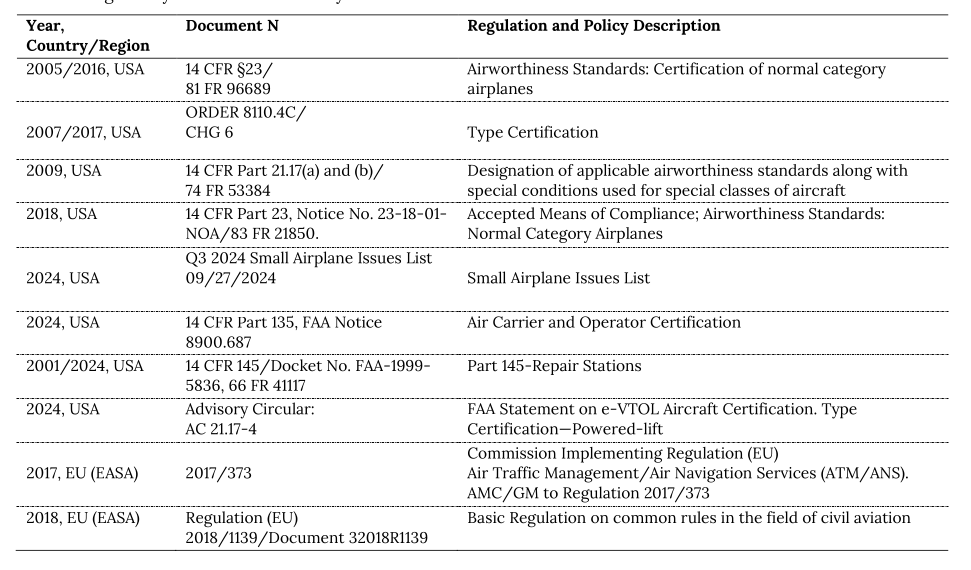
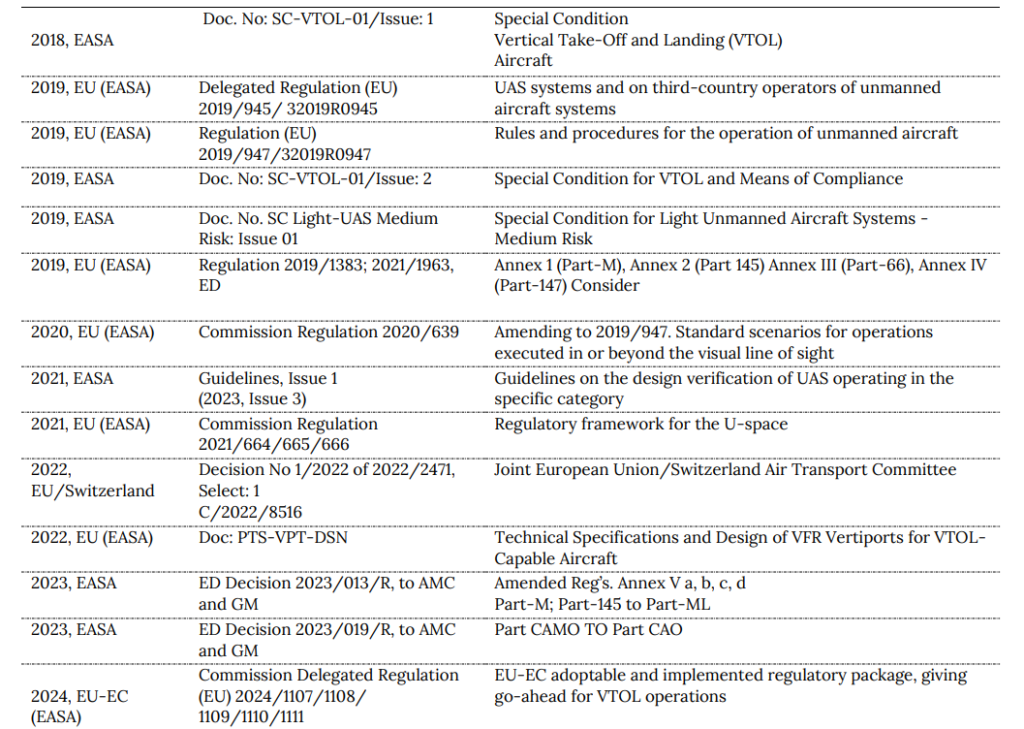
The relatively rapid deployment of e-VTOL air vehicles, ensuring UAM operations, in turn raises concerns about the early stages of regulation and legal frameworks (Straubinger et al., 2020; Babetto et al., 2022; Sells and Crossley, 2022). Actually, the legal aspect includes the regulatory framework (Bauranov and Rakas, 2021; Mitchell et al., 2022). Authorities such as EASA and FAA, which work to establish standards and rules for the safe operation of e-VTOL air vehicles, are currently not subject to any specific restriction (Schuh et al. 2022) for test flights, following the regulatory implementations. This understanding is fundamental for developing effective legal frameworks and regulations that address, e.g., safety, noise, and integration within the manned space associated with air vehicles (Bauranov & Rakas 2021, Sun et al. 2021). Consequently, several initiatives and regulatory frameworks have been established in recent years to facilitate the secure integration of innovative aerial vehicles into urban settings in accordance with existing and forthcoming rules (Keller et al., 2021). The regulatory measures from 2017 to 2024 highlight the explanation of each regulatory item, the creation process, and the advancements achieved. Table 2 delineates the current legislative framework, highlighting the numerous hurdles that e-VTOL operations must surmount for complete integration into the airspace. In the context of managing MRO organizations for eVTOL aircraft, the general rules and regulations rely on existing frameworks applicable to traditional aircraft. The initial version of the basic management infrastructure under Part-145 is still in place, serving to define maintenance strategies for unmanned air vehicles. Due to changes in EASA regulations and issued amendments, Part-M is divided into Part-CAMO for commercial aircraft and Combined Airworthiness Organization (CAO) Part-CAO for light aircraft types by the implementing e-VTOL aircraft. The removal of Subparts G and F from Part-M will take effect from March 2022 for Part-CAMO/CAO. However, several changes to the requirement, applicable to Part-145 approved organizations, will take effect from December 2024. Regulation 1321/2014 allows the connection between the ongoing airworthiness of Part-CAMO/CAO and MRO Part-145 through PART-ML activities. Part-147- trained maintenance staff and Part-66-approved licensed personnel can sign releases to service for specific aircraft types (EASA, 2022; 2023b). In summary, any operation is impeded by the absence of regulations and protocols, service providers, transparent integration with general aviation, and stringent airworthiness standards. These obstacles necessarily undermine the implementation and societal acceptance of the UAM operational system utilizing electric aerial vehicles (Babetto et al., 2023). The paper delineates a regulatory framework that acts as a foundation for overseeing UAM design drivers, particularly those related to e-VTOL aircraft. The legal obstacles might be encapsulated as an inadequate framework of regulations and protocols, coupled with a deficiency of service providers for operations in urban settings, which are essential for ensuring a secure and efficient aerial transportation service. In addition, collaborations between aircraft manufacturers, industry stakeholders, and regulators are crucial for advancing the acceptance and implementation of these aircraft. Hence, there is a necessity to establish guidelines that reflect these specialized operational characteristics. Advances in electric propulsion systems applied to VTOL technology have seen significant improvements, enhancing the efficiency and performance of these aircraft. The application of electric motors powered by high-capacity batteries significantly reduces reliance on traditional fossil fuels, thereby promoting sustainability in aviation. Innovations in battery technology, such as improved lithium-ion and solid-state batteries, have increased energy density and reduced charging times. These developments enable longer flight durations and a more efficient power-to-weight ratio, making electric VTOL aircraft more viable for commercial applications in urban environments (Çorbacı and Doğan, 2023). Hybrid systems combining electric and conventional propulsion methods provide flexibility in operations, which allowing aircraft to operate in regions with limited charging infrastructure while benefiting from lower emissions during flight. The roles of automation and artificial intelligence (AI) are pivotal to shaping future trends in VTOL technology. Through advanced algorithms and machine learning, these technologies enhance flight safety, operational efficiency, and overall passenger experience in vertical takeoff and landing aircraft. AI systems facilitate real-time data analysis, enabling VTOL vehicles to make informed decisions during flight. The integration of automation enhances operational scalability in urban air mobility, allowing multiple VTOL aircraft to navigate congested airspace seamlessly. This interconnected network ensures efficient routing, minimizing delays and maximizing the utilization of air traffic resources. The environmental impact of VTOL aircraft is a critical area of study, particularly as urban air mobility concepts gain traction. Advances in electric propulsion systems are paving the way for reductions in noise and emissions, addressing concerns traditionally associated with aviation technology. Noise reduction technologies, such as quieter rotor designs and sound insulation, are being implemented to minimize the acoustic footprint of VTOL operations. This capability is vital for maintaining harmony in urban environments where aircraft might operate close to residential areas. Implementing regulations to control noise pollution is significant for e-VTOL aircraft operated in urban areas. Taking into account the public’s perception and the social challenges associated with e-VTOL operations is crucial in addressing safety concerns and promoting urban integration among the population, all in line with the UAM concept. There are several countries which actively integrating eVTOL aircraft into their urban air mobility plans that could enhance the practical relevance future UAM operations. Archer Aviation has announced plans to establish an e-VTOL network in Los Angeles. United Airlines has placed orders for over 400 e-VTOLs with Archer Aviation and Eve Air Mobility. This initiative aims to alleviate traffic congestion and provide a sustainable alternative to traditional transportation. Singapore, the city-state, has been actively exploring e-VTOL technology for urban air mobility. Companies like Volocopter have conducted successful test flights in Singapore, showcasing the potential of e-VTOL aircraft in reducing travel times and improving urban transportation. Germany’s company Volocopter has developed the VoloCity e-VTOL aircraft designed for urban air mobility and has undergone extensive testing and certification processes. It aims to provide a quiet, efficient, and environmentally friendly mode of transportation within big cities. Urban Aeronautics Ltd. (now Metro Skyways), based in Israel, has developed the CityHawk e-VTOL aircraft. This aircraft is designed for urban operations and can carry up to four passengers. It features ducted fans for vertical lift and horizontal flight, making it suitable for urban environments. These approaches highlight the diverse applications and potential benefits of e-VTOL aircraft in urban air mobility. They also underscore the importance of infrastructure, regulatory frameworks, and technological advancements in realizing the full potential of this innovative mode of transportation (Kolar et al., 2024; Karsbergen, 2025).
4. Conclusion
The comprehensive framework of UAM using AAM aircraft encompasses multiple facets, involving innovations in technology, design architecture, basic operational structure, social perception, and analysis of market segmentations. Since their design, e-VTOL air vehicles have significantly advanced in battery technologies, propulsion systems, and electric motor enhancement. Numerous studies analyze diverse aircraft and propulsion designs, focusing on the roles of batteries, power electronics, thermal management, and the assessment of urban airspace concepts, including safety operations (Kim et al., 2018; Brelje and Martins, 2019; Bauranov and Rakas, 2021; Kai et al., 2022). The FAA, NASA, and EASA have developed various Concepts of Operations (ConOps) for the future use of Urban Air Mobility (UAM), with a focus on designing low-altitude airspace, managing start-up e-VTOL fleet operators, and establishing legislative frameworks for stakeholders in the UAM business environment. In addition to the existing research, regulatory frameworks play a crucial role in securing a prosperous future for urban transportation by tackling various legal obstacles. Different groups working together to create a UAM regulatory framework makes it easier to make big steps forward in certification, maintaining airworthiness standards, and making sure that reliable safety procedures and effective business plans work well together. This study highlights the need for further scrutiny of issued regulations by involved stakeholders and their partners, who are offering strategic initiatives, to effectively shape the future direction and growth of UAM use cases. Nowadays, the incorporation of UAM into urban air transportation systems presents technological and social problems, regulatory hurdles, and interoperability with current transportation infrastructures. The early stages of regulation and legal status concerning e-VTOL aircraft essentially encompass the regulatory framework that contributes to the establishment of standards and rules for safe operation. Currently, the existing adapted regulations do not impose any specific restrictions on test flights or maintenance activities that support the airworthiness of air vehicles, even after temporary regulatory implementations. This is a fundamental factor for developing effective legal frameworks and regulations that address, e.g., safety, noise, and integration within the manned space associated with air vehicles. In recent years, have been implemented numerous initiatives and regulatory frameworks to ensure the safe integration of novel types of aerial vehicles into the urban environment, adhering to current and future regulations. The presented regulatory steps examined the issued document from 2017 to 2024, highlighted the description of each regulatory item, the development process, and achieved progress. Taking into account the current legal structure, there are some obstacles that must be overcome upon e-VTOL operations to achieve complete integration with the airspace. Overall, the absence of regulations and protocols, service providers, transparent harmonization with general aviation, and strict airworthiness requirements impedes any operation. These challenges inevitably compromise the deployment and public acceptance of the UAM operation system involving electric aerial vehicles. The regulatory framework, as outlined in this study, serves as a foundation for managing the design drivers of UAMs, which are typified by e-VTOL aircraft. The legal challenges can be summarized as an incomplete set of rules and protocols, as well as a lack of service providers for operations in the urban environment, which are crucial for providing a safe and efficient aerial transportation service. Predictions for the future consider in increased adoption of the battery technology and autonomous systems continue to improve, that can expect a significant increase in the adoption of e-VTOL aircraft for urban air mobility. On the other hands the infrastructure development including vertiports and charging stations will become a priority to support the growing fleet of eVTOLs. International regulatory bodies will work towards harmonizing standards to facilitate the global deployment of e-VTOL aircraft for successful UAM operations. Regulatory organizations should collaborate closely with industry stakeholders to develop regulations that address the unique challenges of e-VTOL technology. Streamlining the certification process for e-VTOL aircraft will ensure safety without stifling innovation. Regulations should be focused on prioritize safety and sustainability, ensuring that e-VTOL operations do not compromise public safety and environmental standards. Investment in Public Awareness and Education will be major benefits for safety measures associated with eVTOL technology (EASA, 2023).
CRediT Author Statement
Tapdig Imanov: All dimensions of the research are
conducted by Tapdig Imanov.
Nomenclature
AAM : Advance Air Mobility
ATC : Air Traffic Control
ATM : Air Traffic Management
CAA : Civil Aviation Authority
CAO : Combined Airworthiness Organization
CNS : Communication Navigation Surveillance
DOT : Department of Transportation
EASA : European Aviation Safety Agency
EC : European Commission
EU : European Union
e-VTOL : Electric Vertical Takeoff and Landing
FAA : Federal Aviation Administration
FCL : Flight Crew Licensing
IATA : International Aviation Transport
Association
ICAO : International Civil Aviation Organisation
ICT : Information and Communication
Technology
ITF : International Transport Forum
MP : Maintenance Program
MPD : Maintenance Planning Document
MRO : Maintenance Repair Overhaul
NASA : National Aeronautics and Space
Administration
NCAO : National Civil Aviation Organization
SERA : Standardized European Rules of the Air
UAM : Urban Air Mobility
UAV : Unmanned Air Vehicle
References
Afridi, S., Khan, T.A., Shah, S.I.A., Shams, T.A., Mohiuddin, K. and Kukulka, D.J., 2023. Techniques of Fluidic Thrust Vectoring in Jet Engine Nozzles: A Review. Energies, 16(15), p.5721.
Al-Rubaye, S., Tsourdos, A. and Namuduri, K., 2023. Advanced air mobility operation and infrastructure for sustainable connected evtol vehicle. Drones, 7(5), p.319.
An Aviation Services., 2024. Understanding International Aviation Regulations. Available at: https://an.aero/international-aviation-regulations/, Accessed 25.10.2024
Arco, A., Do Vale, J. L., Bazzocchi, S., & Suleman, A., 2023. Investigation on the Airworthiness of a Novel Tri-Rotor Configuration for a Fixed Wing VTOL Aircraft. International Journal of Aviation Science and Technology, 4(02), 53-62.
Babetto, L., Kirste, A., Deng, J., Husemann, M. and Stumpf, E., 2023. Adoption of the Urban Air Mobility System: Analysis of technical, legal and social aspects from a European perspective. Journal of the Air Transport Research Society, 1(1), pp.152-174.
Babetto, L., Kniebel, B. and Stumpf, E., 2022. SORA-Based Risk Assessment for Cargo Unmanned Aerial Vehicles in the UAM Framework. In Proceedings ICAS (Vol. 2022).
Bauranov, A. and Rakas, J., 2021. Designing airspace for urban air mobility: A review of concepts and approaches. Progress in Aerospace Sciences, 125, p.100726.
Bellan, R., 2024. Feds clear way for EVTOL startups to bring flying vehicles to U.S. airspace. Available at: https://techcrunch.com/2024/10/22/evtol-startups-just-got-a-big-lift-from-the-usgovernment, Accessed 25.10.2024
Brelje, B.J. and Martins, J.R., 2019. Electric, hybrid, and turboelectric fixed-wing aircraft: A review of concepts, models, and design approaches. Progress in Aerospace Sciences, 104, pp.1-19.
Bugaj, M., Urminský, T., Rostáš, J., Pecho, P., 2019. Aircraft maintenance reserves–new approach to optimization. Transportation Research Procedia. 1(43):31-40. https://doi.org/10.1016/j.trpro.2019.12.016
Çorbacı, F. K., & Doğan, Y. E. (2023). An Approach to Preliminary Design of a Quadrotor Cargo UAV. International Journal of Aviation Science and Technology, 4(02), 63-74.
Dinç, A., 2020. Sizing of a Turboprop Engine Powered High Altitude Unmanned Aerial Vehicle and Its Propulsion System for an Assumed Mission Profile in Turkey. International Journal of Aviation Science and Technology, 1(01), 9-13.
Du, H., and Heldeweg, M., 2018. “An experimental approach to regulating non-military unmanned aircraft systems”, International Review of Law, Computers & Technology, Vol. 33/3, pp. 285-308, https://doi.org/10.1080/13600869.2018.1429721
EASA., 2010. Maintenance Organization Approvals – PART 145. https://www.easa.europa.eu/sites/default/files/dfu/rulemaking-docs-technical-publications-Partial-Part-145.pdf, Accessed, 16.10.2024
EASA., 2019. Special Condition Vertical Take-Off and Landing (VTOL) Aircraft. Available at: https://www.easa.europa.eu/en/domains/rotorcraft-vtol/VTOL, Accessed 04.10.2024
EASA., 2021. Study on the societal acceptance of Urban Air Mobility in Europe. Available at: https://www.easa.europa.eu/sites/default/files/dfu/uam-full-report.pdf, Accessed 19.10.2024
EASA., 2022. Guide for Compliance with Part-145 As Amended by EU Regulation 2021/1963 (Revision June 2022). Available at: https://www.easa.europa.eu/en/downloads/136744/en.PDF file, Accessed 25.10.2024
EASA., 2023a. EASA proposes rules for VTOL operations, including air taxis. Available at: https://www.easa.europa.eu/en/newsroom-and-events/press-releases/easa-proposes-rules-vtol operations-including-air-taxis. Accessed: 22.10.2024.
EASA., 2023b. ED Decision 2023/013/R. Available at: https://www.easa.europa.eu/de/document-library/agency-decisions/ed-decision-2023013r, Accessed, 26.10.2024
EASA., 2024. European Commission adopts regulatory package, giving go-ahead for VTOL operations and air taxis. Available at: https://www.easa.europa.eu/en/newsroom-and-events/news/european-commission-adopts-regulatory-package-giving-go-ahead-vtol, Accessed 25.10.2024
European Commission., 2021. Drones: Commission adopts new rules and conditions for safe, secure and green drone operations, https://ec.europa.eu/transport/modes/air/news/2021-04-22-drones_en, Accessed on 22. 10.2024.
FAA., 2014. Standardized Procedures for Usage of Issue Papers and Development of Equivalent Levels of Safety Memorandums FAA Order 8110.112A.
FAA., 2017. National Policy: Type Certification, Order – 8110.4C
FAA., 2018. Accepted Means of Compliance; Airworthiness Standards: Normal Category Airplanes. A Rule by the Federal Aviation Administration, Published Document: 2018-09990 (83 FR 21850)
FAA., 2022. FAA Small Airplanes Issue List (SAIL), Release, at 3280. Last updated: Monday, September 30, 2024
FAA., 2024a. 14 CFR Part 135 Air Carrier and Operator Certification. FAA Notice 8900.687, Last updated: Wednesday, January 24, 2024
FAA., 2024b. Code of Federal Regulation (CFR). ttps://www.ecfr.gov/current/title-14/chapter-I/subchapter-H/part-145?toc=1, Accessed, 23.10.2024
Finn, R. and Donovan, A., 2016. Big data, drone data: Privacy and ethical impacts of the intersection between big data and civil drone deployments. The Future of Drone Use: Opportunities and Threats from Ethical and Legal Perspectives, pp.47-67. Asser Press, The Hague.
Gesley, J., Feikert-Ahalt, C. and Law Library of Congress (U.S.). Global Legal Research Directorate., 2023. Regulation of advanced air mobility: European Union, United Kingdom. [Washington, D.C.]: The Law Library of Congress, Global Legal Research Directorate. Available at: https://hdl.loc.gov/loc.law/llglrd.2023555903, Accessed 27. 10. 2024.
Goodrich, K.H., and Theodore, C.R., 2021. Description of the NASA urban air mobility maturity level (UML) Scale. In: AIAA Scitech 2021 Forum. VIRTUAL EVENT: American Institute of Aeronautics and Astronautics
Haynes, B., and Alerigi, A.J., 2016. Uber offers helicopters to escape Sao Paulo gridlock. Available at: https://www.yahoo.com/news/uber-offers-helicopters-escape-sao-011656543.html, Accessed 19.10.2024
Holden, J., Goel, N., 2016. Fast-Forwarding to a Future of On-Demand Urban Air Transportation, White paper
International Transport Forum., 2021. Ready for Take-Off? Integrating Drones into the Transport System. Available at: https://www.itf-oecd.org/sites/default/files/docs/take-off-integrating-drones-transport-system.pdf, Accessed 24.10.2024
Jones, T., 2017. International commercial drone regulation and drone delivery services (No. RR-1718/3-RC). Santa Monica, CA, USA: RAND. https://doi.org/10.7249/rr1718.3.
Kai, W., Jacquillat, A. and Vaze, V., 2022. Vertiport planning for urban aerial mobility: An adaptive discretization approach. manufacturing & service operations management, 24(6), pp.3215-3235.
Karsbergen, K., 2025. EVTOLs Are Revolutionizing Urban Air Mobility: Can Airlines Catch Up? Available at: https://www.air52.com/aviation-insights/evtol-revolution-airline-strategies, Accessed 19.02.2025
Keller, M., Hulínská, Š. and Kraus, J., 2021. Integration of UAM into cities–the public view. Transportation Research Procedia, 59, pp.137-143.
Kim, S., Harris, C.M., Justin, C.Y. and Mavris, D.N., 2022. Optimal Trajectory and En-Route Contingency Planning for Urban Air Mobility Considering Battery Energy Levels. In AIAA AVIATION 2022 Forum (p. 3415).
Kolar, J. W., Menzi, D., Imperiali, L., Burgisser, E., & Huber, J., 2024. e-VTOL Aircraft. The Future of Urban Air Mobility. In 10th International Power Electronics and Motion Control Conference (IPEMC 2024-ECCE Asia).
Liu, Y., Wang, T., Zhang, H., Cheutet, V., Shen, G., 2019. The design and simulation of an autonomous system for aircraft maintenance scheduling. Computers & industrial engineering. 137:106041.
Memon, O., 2023. Lift And Cruise: The Ins & Outs Of eVTOL Design Architecture. Available at: https://simpleflying.com/lift-cruise-evtol-design-architecture-guide/, Accessed 20.10.2024
Mitchell, D.G., Klyde, D.H., Shubert, M., Sizoo, D. and Schaller, R., 2022. Testing for certification of urban air mobility vehicles. In AIAA SciTech 2022 Forum (p. 0889).
Noble, Z., 2023. A need for more aircraft maintenance engineers for Evtol. Available at: https://aviationintertec.com/a-need-for-more-aircraft-maintenance-engineers-for-evtol/, Accessed 15.10.2024
Pagallo, U., and Bassi, E., 2020. “The Governance of Unmanned Aircraft Systems (UAS): Aviation Law, Human Rights, and the Free Movement of Data in the EU”, Minds and Machines, Vol. 30/3, pp. 439-455, https://doi.org/10.1007/s11023-020-09541-8.
Partheepan, S., Sanati, F., and Hassan, J., 2023. Autonomous Unmanned Aerial Vehicles in Bushfire Management: Challenges and Opportunities. Drones, 7, 47.
Quan, Q., Dai, X. and Wang, S., 2020. Multicopter design and control practice: a series experiments based on MATLAB and Pixhawk. Springer Nature. Pp 1-14
Roger, J., 2023. MROs, eVTOL Manufacturers Begin Collaborating on Maintenance Ecosystem. Available at: https://aviationweek.com/mro/emerging-technologies/mros-evtol-manufacturers-begin-collaborating-maintenance-ecosystem-0, Accessed 18.10.2024
Roland Berger., 2020. Urban Air Mobility USD 90 billion of potential: How to capture a share of the passenger drone market.
Sanchez, D.T., Boyacı, B., Zografos, K.G., 2020. An optimisation framework for airline fleet maintenance scheduling with tail assignment considerations. Transportation Research Part B: Methodological. 1(133):142-164.
Schuh, G., Krebs, L., Babetto, L., Kniebel, B., Spangenberg, M. and Stumpf, E., 2022. Technical and Legal Boundary Conditions for the Extension of the Air Cargo Logistics Chain by UAVs into the City Centre.
Sells, B.E., and Crossley, W.A., 2022. Modeling Review and Recommendations for Ubiquitous Urban Air Mobility Operations. In AIAA AVIATION 2022 Forum (p. 3793).
Sriram, C., and Haghani, A., 2003. An optimization model for aircraft maintenance scheduling and re-assignment. Transp. Res. Part A: Policy Pract. 37 (1): 29–48.
Straubinger, A., Rothfeld, R., Shamiyeh, M., Büchter, K.D., Kaiser, J. and Plötner, K.O., 2020. An overview of current research and developments in urban air mobility–Setting the scene for UAM introduction. Journal of Air Transport Management, 87, p.101852.
Sun, X., Wandelt, S., Husemann, M. and Stumpf, E., 2021. Operational Considerations regarding On‐Demand Air Mobility: A Literature Review and Research Challenges. Journal of Advanced Transportation, 2021(1), p.3591034.
Uber., 2019. Introducing Uber Copter. Available at: https://www.uber.com/blog/new-york-city/uber-copter/, Accessed 26.10.2024
VFS., 2024. eVTOL Aircraft Directory. Available at: https://www.evtol.news/aircraft, by the Vertical Flight Society, Accessed 11.10.2024
Vijayakumar, J.P., 2019. Global Urban Air Mobility Market Heads for Takeoff, Powered by Air Taxi Services. Frost & Sullivan.
World Economic Forum., 2019. Advanced Drone Operations Toolkit: Accelerating the Drone Revolution. Available at: https://www.weforum.org/publications/advanced-drone-operations-toolkit-accelerating-the-drone-revolution/, Accessed 28.10.2024
Yan, Y., Wang, K. and Qu, X., 2024. Urban air mobility (UAM) and ground transportation integration: A survey. Frontiers of Engineering Management, pp.1-25.