
Abstract
Boeing’s efforts to develop next-generation aircraft types and present them to customers have been unsuccessful due to delayed deliveries caused by technological and management issues. The evident challenges with the Boeing 737 MAX, the initial postponement of the delivery of the Boeing 787 Dreamliner due to organizational processes in the supply chain, and the current delays in the delivery of the Boeing 767 and Boeing 777 types have impacted the company’s financial performance. The study aims to analyze the reasons behind these challenges, identify critical factors influenced by the delivery process, and reveal the financial losses resulting from delayed aircraft deliveries. The study’s findings reveal that Boeing faces unpredictable customer issues and intense stakeholder pressure to pay late delivery penalties, leading to significant impacts on the production schedule and financial downturn. Boeing Company, along with a postponed entry schedule to service for early ordered aircraft, has indeed contributed to global delivery issues, resulting in a three-year delay and significant penalties.
Keywords
- Boeing Company
- Aircraft
- Delivery
- Delay
- Supply Chain Management
- Financial Analysis
1. Introduction
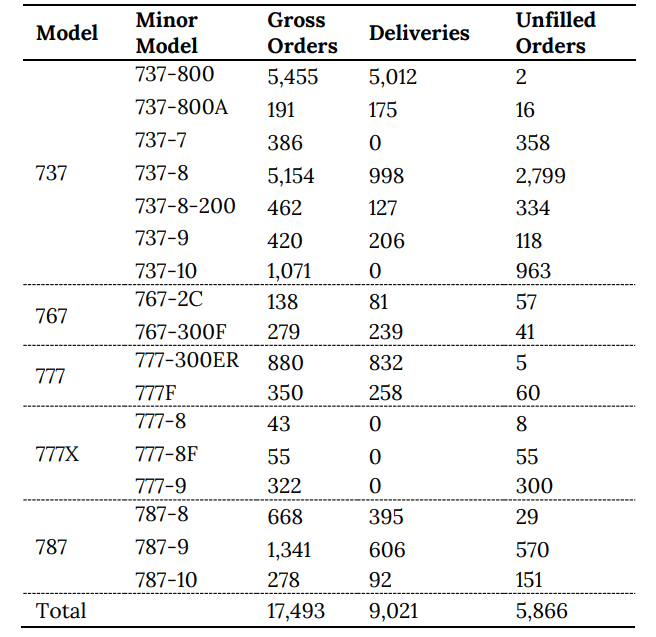
Since its establishment, Boeing has designed, manufactured, implemented, and delivered thousands of commercial aircraft worth hundreds of billions of dollars to customers in more than 150 countries. Through the implementation of new technology programs, the aerospace industry has introduced a novel production system to develop the next generation of aircraft. On the other hand, the aviation industry has a highly globalized market structure, making the role of involved stakeholders increasingly crucial in delivering ordered products to potential customers. As the production of aircraft increases, the manufacturer’s influence on the distribution process also increases. Consequently, the management of supply chain strategy is becoming increasingly crucial to prevent delays in delivery and production processes (Mocenco, 2015). Due to the increasing demand for air transportation and the continuously expanding aviation industry, Boeing has become a leading exporter of commercial aircraft, leveraging a global supplier base to enhance its economic capabilities. Nowadays, the company produces the narrow-body Boeing 737 family and the wide-body Boeing 747, 767, 777, and 787 families of airplanes. Nearly 10,000 next-generation commercial jetliners, including the Boeing 737 MAX, 787-10 Dreamliner, and Boeing 777 X, are currently in service worldwide; however, 5866 aircraft remain undeliverable (Boeing, 2023), Table 1. In order to meet customer requirements, the supply chain management structure of the Boeing company must offer multi-stage multinational operations to ensure proper delivery of its outstanding orders (Behrens, 2010). Apart from the aviation industry, many companies face challenges due to the pressure to meet customer requirements (Miron-Spectar et al., 2011). Consequently, the rapid progress in aircraft manufacturing in recent years has led to high-risk supply chain management, which is vulnerable to the delivery plan (Treuner et al., 2014). Boeing reported operating losses of about 650 million USD in Quarter 4, 2022, contrary to expectations that the aircraft giant would turn a profit. The company attributed the unexpected loss to the delivery of the remaining backlog of Boeing 737 MAX and increased deliveries of the Boeing 787 “Dreamliner,” whose production remains below scheduled rates (Asian Aviation, 2023). Similar to the Boeing 737 MAX, the FAA reported quality issues with the company’s Boeing 787, which impeded their delivery to customers. Furthermore, Boeing had to compensate purchasers of Boeing 787 aircraft for a year’s delay in delivery (Isidore, 2023). Boeing acknowledged the problem and subsequently declared that it would rectify the production defects affecting the delayed 100 Dreamliner aircraft before delivery (Reid, 2023) and that it might postpone the delivery of 400 Boeing 737 MAX aircraft, each scheduled for 2023 (Attarwala, 2023). Due to grounded Boeing 737 MAXs and undelivered Boeing 787 “Dreamliners,” Boeing has lost $383 million in continuing spending to fix the problems, which are facing uncertainty in deliveries (Gates, 2023). Following to several literature reviews and scientific analyses of the fields involved in practical application, the main challenges consist of management in supply chain loops. Boeing’s subcontractors face numerous challenges in sourcing raw materials and components for aircraft assembly from various countries. Innovative advancements have exposed numerous electronic devices to software applications that impact the delivery of aircraft to clients. Commercial air transportation is experiencing rapid growth and is now servicing innovative new-generation aircraft models. In the context of modernizing fleet availability, many leading global airline companies have prioritized the purchase of new models of the Boeing 737 MAX and Boeing 787 family, with the aim of reducing overall operating costs and ensuring their customers receive high-quality services on these ultra-modern aircraft. However, the airlines have placed orders for these aircraft, which the manufacturer often struggles to deliver within the scheduled time frame. Meanwhile, a delay in the intended period results in significant losses for the company, which in turn necessitates significant compensation for its customers. In reality, the high volume of orders for commercial aircraft can lead to significant financial risk for leading manufacturers, and this remains the primary factor (Richardson, 1969). To lower the risk associated with financial performance, it is necessary to predict innovation failures and, meanwhile, identify critical success factors of novel products offered to customers (Ernst, 2002).
Table 1. Boeing Airplanes Orders and Deliveries (Boeing, 2023)
Implementing new technologies, transitioning from a vertical supply structure to a multinational operation, and strengthening regulatory compliance have created challenges in supply chain management. Therefore, Boeing must take immediate and effective steps in communication to identify the necessary solutions to address issues during program development and production (Gordon, 2006; Behrens, 2010; Mayer, 2014). This study is crucial as it aims to warn leasing organizations and airlines ordering aircraft from the Boeing company about the potential delays in delivery. This should prompt them to reevaluate their purchase agreements and address any gaps in the terms to prevent future disruptions to assigned flight schedules. The investigation has identified the primary issues with technological failure and supply chain management, which significantly contribute to delays on aircraft production lines. Therefore, the study aims to analyze and identify the financial losses incurred by the Boeing company in the event of a scheduled delivery deviation, as well as its impact on production processes. 1.1 Review of the Literature Many studies attempt to analyze the unsuccessful confluence of programs dedicated to Boeing 737 MAX and Boeing 787 “Dreamliner” projects. Some authors focused on the investigation of Boeing 737 MAX crashes to find the root cause of the accidents; others concentrated on finding ongoing delays in the delivery of Boeing 787, identifying critical factors, and related risks. Tzu-Ching (2007) found that Boeing’s new supply chain model for the 787 Dreamliner program diverged from its previous experience, while Airbus relied on its major suppliers for the Airbus A380 program, who exercised much greater and more intensive control. Despite making significant capital investments and exerting considerable effort, Boeing continues to experience a series of delays in the delivery of its aircraft to customers. Tang et al. (2009) found that an inappropriate management team, a lack of coherent strategies, and a lack of effective proactive risk assessment were the root causes of the problems. The study conducted by Mocenco (2015) sheds light on a number of factors related to the supply chain management of the Airbus A350XWB and Boeing 787 “Dreamliner” aircraft programs. The study’s results show that changes in strategic and organizational models led to more outsourcing, which hurts performance, dependability, and financial stability. In addition to the risks associated with outsourcing, Sodhi et al. (2012) identified other effective solutions to reduce the risks associated with supply chain management. Based on past mistakes, these solutions offer four recommendations to address the current issues Boeing is facing. According to Schmuck (2021), the design stage and assembly processes for the Boeing 787 faced significant challenges due to numerous innovation implementations and labor and management risks, which resulted in the first aircraft delivery occurring three years later than scheduled. The author argues that the major challenge was managing the global supply chain and ensuring quality integration. Digitization and improved supply chain quality contributed to the development and production process through the Boeing 787 “Dreamliner” project. Woo et al. (2021), focusing on an analysis of the competitive actions of Boeing and Airbus, concluded that hard pressing on behalf of Airbus pushed Boeing to reconsider the business diversification options and risk- taking culture. The study by Kuczynski et al. (2021) that looked into the accidents and the Boeing 737 MAX supply chain mishandling found a serious problem that was caused by a lack of leadership from central authority and a focus on making money for the company at the expense of public safety. Critical reasons refer to the inevitable and possible occurrence of crises in any stage of production and organizational processes. The study by Imad et al. (2021) looked at two Boeing 737 MAX accidents from the point of view of how to communicate and manage a crisis. The results convinced Boeing to create a crisis management framework to handle tough situations and unexpected risks. Openness and integrity to share information with media groups and the public create confidence (Coombs, 2010); unfortunately, after the double crashes of the Boeing 737 MAX, Boeing hid the transparency and has faced several productions and setbacks (Chakrabarty and Bass, 2013). According to Camble et al. (2023), the accidents involving the Boeing 737 MAX are not solely due to technical issues in the system or proactive pilot actions, but also to inappropriate leadership within an organization that prioritizes profitability over safety. Referring to the pilot’s comments, Sumner (2019) reported that on both flights, except for the Maneuvering Characteristics Augmentation System (MCAS), which dealt with the sensor angle of attack, we had issues with maintenance, pilot practices, training, and the costs and benefits of the flights. Meanwhile, Boeing has failed fully, attempting to avoid the responsibility, leaving it to the customers and local authorities to ground the aircraft (Matthews, 2019). In turn, Palmer (2020) called this approach unstable communications, weak in crisis management, and critical behavior on behalf of the Boeing company. In spite of common accusations against Boeing, the novel technological complexity applied in the aviation industry carries a high degree of technical and managerial risks and financial uncertainty. Identifying priorities and critical success factors is vital at the beginnings of innovation projects (Jelac and Boljevic, 2016). 1.2 Factors and Reasons of Negative Effect on Aircraft Delivery The aviation industry is the most vulnerable sector, requiring permanent development with innovative implementation. Boeing’s concept, which applies intelligent technologies to design new generation aircraft types, contributes significantly to operator savings, reduces environmental degradation, and ensures societal satisfaction. Achievements in the development of new products enable the company to maintain its competitiveness over the long term, but they also introduce high risk, complexity, and uncertainty into the production processes. Therefore, a key approach is mandatory to identify potential challenges and critical reasons in the stage of beginning the idea generation and its future implications, which Boeing faced in the production of the Boeing 737 MAX and Boeing 787. The company’s non-compliance with the scheduled delivery of the new generation aircraft, the Boeing 787 “Dreamliner”, and two crashes of the Boeing 737 MAX resulted in a negative reputation and significant financial losses. The Boeing 737 MAX was grounded and the Boeing 787 production process was extended, which ultimately caused the delivery to be three years later than planned. This was because potential risks and critical factors were not properly identified during the innovative production process, and there was not enough comprehensive supply chain management.
Table 2. Supply chain management solutions between Boeing and Airlines
|
Boeing |
Airlines |
|
High quality supply chain management structure Avoid of risk-sharing suppliers To manage the complex programs for stock availability Immediate stock planning of new components To perform effective training program Proper logistic Management and expand workforce To conduct periodic quality audit Multi-channel communications with vendors Improvement of the delivery deadline |
Sufficient stock availability of AOG parts Raw materials and consumables for scheduled and unscheduled maintenance High financial investment for offered RSPLs Order tracking Information sharing between planners and suppliers Periodic training plan Upgrade the supplier list Availability of tools and ground equipment |
Numerous airlines and leasing companies have declined purchase orders and terminated agreements because they lack confidence in the suitability of new products. The Boeing 737 MAX air crash was caused by a defect in an aircraft part, and in addition to the airline, the aircraft manufacturer also bears liability, as the aircraft was operated under an airworthiness warranty. In addition, the company lost USD 30 billion in its market value, and shareholders brought a class action lawsuit because of the loss of shares’ value (Konert, 2019). Collings et al. (2022) discovered that the Maneuvering Characteristics Augmentation System (MCAS) software, which is in charge of keeping the pitch stability, was linked to both fatal accidents. Focusing on competitions with the Airbus A320 Neo, Boeing faced financial pressure, which led to a heavy reliance on the completion of the 737-MAX program (Cioroianu et al., 2021). The manufacturer is responsible for approximately ten percent (10%) of the assembly of the Boeing 787 aircraft, which consists of approximately 4 million parts and components. The fact that the distribution of most component which production facilities is spread out among 40 partners around the world makes for a weak global collaborative supply chain environment (Xu et al., 2021), which in turn affects the productivity of the B787 production line. The tightening and overloading of the work schedule resulted in production organizational issues. This was followed by delays in receiving parts from both internal and external suppliers from different countries. Technical issues during functional tests
2. Method
2.1 Data Collection
The empirical analysis uses official statements from Boeing to collect the number of aircraft sold from 2010 to 30 November 2023. Given that the OEM and customer mutually adhere to the delivery schedule for other models, this study will concentrate on the remaining four types of aircraft. However, the preparation of data for analysis will be based on the selection of historical annual orders, the number of delivered aircraft, and the number of unfilled orders (Table 3). After the two included incomplete software and defects in control and power systems. The test flight results showed negative effects, leading to the postponement of the first delivery. In addition to the technical challenges encountered during the production process of the Boeing 787, the organization’s human factors significantly contributed to dissatisfaction with the contract conditions (Jelac and Boljevic, 2016). The implementation of new-generation aircraft, with a modified composite body fuselage and electronic fuel flow control units, AS WELL AS a fly-by- wire navigation system, creates some complexity for the aircraft Original Equipment Manufacturer (OEM) by providing a spare part in a timely manner for their customers. The development of new approaches is necessary to minimize losses in the supply chain and delivery process. Table 2 shows several implementations that can contribute to mutual collaborations and increase the supply performance. Meanwhile, it avoids the unexpected financial costs and savings associated with supply management. Despite numerous proposed and implemented solutions and diligent efforts to minimize risk, Boeing continued to experience incomplete orders, leading to financial losses. The following sections attempt to analyze the financial losses resulting from postponed delivery and describe the estimated sum of customer reimbursements. The structure of the paper is as follows: Section 2 introduces a Method, Section 3 consists of the result and discussion, and finally Section 4 represents a conclusion. accidents of the Boeing 737 MAX, a total of 7502 aircraft were purchased; the most customers rejected 1600 aircraft, and the purchase agreement was canceled.
Table 3. Aircrafts order status and unit price (Boeing, 2023)
|
Aircraft type |
737 MAX |
767 |
777 |
787 |
|
Orders (E.A) |
6126 |
425 |
1403 |
1349 |
|
Delivered (E.A) |
1376 |
314 |
887 |
1099 |
|
Unfilled order (E.A) |
4526 |
111 |
516 |
744 |
|
Unit price (M/USD) |
107.4 |
198.2 |
336.7 |
265.1 |
*Note: Due to a variety of aircraft configuration the price for each aircraft is indicated as an average.
2.2 Quantiative Analysis Method
This study is exploring the financial losses of the Boeing company in relation to delivery delays, which involve two aircraft types, mostly the Boeing 737 MAX and Boeing 787 Dreamliner. System configuration problems ensure pitch stability in the first aircraft, while the supply of components from third-party subcontractors accompanies the second aircraft. The model incorporates the late delivery issues of Boeing 767/777 aircraft to accurately identify economic downturns.
This study utilizes the quantitative analysis method to ascertain the optimal loss rate for Boeing, thereby identifying the current and future perspectives of ordered aircraft. Model development involves the use of mathematical models to represent real-time problems through a system of econometric (mathematical) formulas for statistical analyses. One must weigh the costs and benefits when choosing a suitable mathematical model. The next step involves relating the decision variables, which are controllable inputs, with either fixed or variable parameters, which are uncontrollable inputs. Generally, stochastic models are more difficult to analyze. However, the optimal solution for the model refers to the values of the decision variables that yield the mathematically best output. Therefore, applying the model can define the loss of price level returned by Boeing to meet customer requirements. On the other hand, the review contributes to defining future operational concepts and policy requirements to improve financial stability.
The relationship between the modeling of delivery losses and total revenues is stipulated in Eq (1), which is formulated using the function proposed as;
T0a/c = f (B3 + B6 + B7 + B8) (1)
T0a/c is aircraft production rate in period from 2010 to 2023,
B3 + B6 + B7 + B8 identified as Boeing 737 / 767 / 777 / 787 aircraft types.
To investigate the total predicted income and impact of losses in long run, the proposed structured model will be chosen as follows:
Ppo = (P1B3 + P2B6 + P3B7 + P4B8) (2)
Ppo is total profit gaining by company from sales according to delivery report and
P1, P2, P3, and P4 are aircraft average sale prices.
TLuo = P1A3 + P2A6 + P3A7 + P4A8 (3)
TLuo is total loss from unfilled aircraft orders, and
A3, A6, A7, A8 are unfilled aircraft orders.
2.3 Methodology
The methodology based on the Quantitative Analysis approach, uses a mathematical model through a system of mathematical formulas.
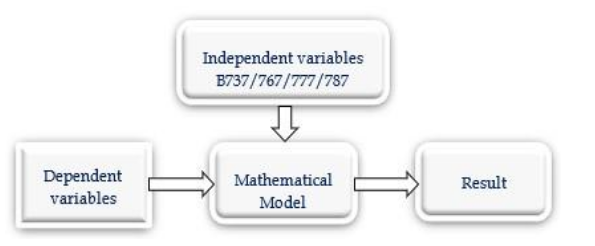
Fig. 1. Proposed methodology for the study
Dependent variables have been chosen the 𝑇𝑂𝑎/c, 𝑃𝑝𝑜, 𝑇𝐿𝑢𝑜
while independent variables are representing the aircraft types with late delivery. Transforming the input data in model by testing and validation, the estimated result can be generated for accurate analysis. Therefore, the methodology formulated according to Figure 1.
The primary issues with the incompleteness of aircraft deliveries are mainly related to technological failure and supply chain management, which contribute to delays in aircraft production lines. Investigation of financial losses and the impact of late aircraft delivery were identified by relying on Boeing’s reported document, which indicated the number of delays by aircraft type. Following the proposed methodology function, the estimated financial losses of the Boeing company have been calculated using the Quantitative Analysis Equations as stated in section 2.3.
3. Results and Discussion
Taking into account a variety of purchased aircraft types and postponing their delivery to potential customers is deemed a complicated problem due to the initially disrupted management process. The seller and buyer usually consider the mutually agreed estimated delivery schedule upon order placement; however, the manufacturer has failed to predict the associated risk level. In this case, proactive action could be taken upon implementing delivery schedules, thereby preventing unexpected violations and bearing penalties associated with delays. The lack of robustness during production planning has made the delivery schedule less sensitive to uncertain events that disrupt the process. Boeing’s application of a robust optimization model for order assignment is currently unavailable due to a backlog of 5897 aircraft across four different types. Since 2010, multiple airline customers have placed total orders for the listed aircraft types, totaling 9303 aircraft valued at
657.9 billion USD for the Boeing 737 MAX, 84.2 billion for the Boeing 767, 472.4 billion for the Boeing 777, and 357.6 billion for the Boeing 787, totaling 1.6 trillion USD, as shown in Figure 2.
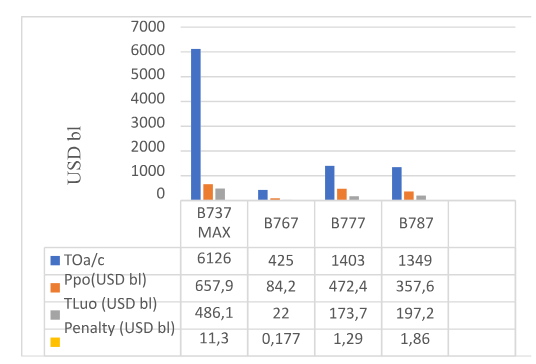
Fig. 2. Boeing aircraft orders, deliveries, and unfilled order status presented in price equivalents
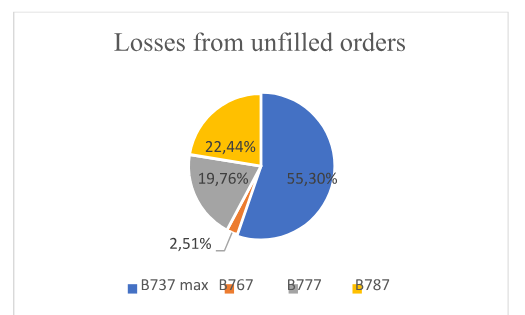
There is evidence that a special article in the contracts promises a delivery schedule of purchased aircraft by the year of date or consequence of next dates depending on the type and number of orders by customers. A separate clause in the contract outlines the late delivery condition, which is associated with penalty issues and order cancellation procedures. Boeing’s significant delivery backlog has resulted in economic weakness for the company, leading to additional penalties. The number of incomes deducted associated with late delivery accounted for about 879 billion USD, nearly 55.3% of losses accumulated from the Boeing 737 MAX, Figure 3.
The industrial disruptions over the past years in the aviation industry associated with the delay in the delivery of commercial aircraft are brewing the compensation challenges for manufacturers. Blaming post-pandemic havoc in the supply chain, the aircraft manufacturer postponed delivery of new aircraft three to six months late. The number of compensations varies depending on the condition of the contract; however, typical exposure is for an inexcusable delay, which may reach 20K USD per outstanding day for single-aisle jets and may rise of USD 2–3 million per aircraft (CNBC, 2023). In this case, the total loss associated with paying penalties on behalf of Boeing to their customers can reach 14.7 billion USD for the coverage period of fulfilling the orders. Large leasing companies are exerting pressure on Boeing due to unexpected delays; additionally, airlines and other purchasers receive announcements and notifications about the upcoming delays. Purchase contracts contain detailed descriptions identifying excusable delays as “acts of God,” which secure manufacturers from paying penalties for multiple types of delays. The term “non-excusable” refers to any delays that do not fall under the stated exclusive category. The grounding of the Boeing 737 MAX due to design defects was considered a significant non- excusable delay, leading to significant compensation payments from Boeing. That event may not promise cash flow at this stage because of extensions of delivery transferring to next year. There is an inverse relationship between aircraft delivery and airline profit, which means that excessive orders can lead to a decline in projected profit and incur airline loss (Jordan, 1998). The delayed delivery of Boeing 787 aircraft has persisted for over a year, resulting in penalty payments reaching 5.1 billion. As a form of compensation, many airlines have accepted the use of interim Boeing 767 aircraft (Anselmo, 2009). The Boeing 787 project promised a path to profitability, and its realization aims to increase production (Lu, 2010; Lu, 2013). However, the grounding of the Boeing 787 in 2013 once again focused not only on battery problems but also on other issues that came to light with the Critical Systems Review Team (CSRT) report (FAA, 2014; Pandian et al., 2020). Consequently, the delivery schedule had an impact, necessitating the rectification of shortcomings. Additionally, the recent fatal events involving the Boeing 737 MAX prompted designers to refocus their investigations on the reliability of the systems and operational features. According to several studies and polls of technical and quality staff working on the Boeing 787 project, the quality of this plane is not as good as was thought to be. To avoid problems with late deliveries, there are large-scale programs to improve the design performance of Boeing planes after safety and reliability. (Cole, 2019). Due to a supplier’s quality mistake, manufacturing the fuel tanks has prompted Boeing to delay deliveries of Boeing 767 aircraft, which began following the recent resumption of the Boeing 787 Dreamliner deliveries after discovering an error in the structural parts. An earlier forecast to complete the certification of Boeing 777 family aircraft, which has been in development since 2013, was expected at the end of 2023; however, the plan faced delays because of certification queries from safety regulators.
In spite of hard attempts, the delivery of the Boeing 777-
9 and 777X is now postponed 2 years later, which is expected to start operation in 2025 (Oxborrow, 2022). Boeing has reported that in the first quarter of 2022, the revenue was $14.0 billion, driven by lower defense volume and partially offset by commercial services volume, while the net loss was $1.21 billion and the operating cash flow was about $3.2 billion, respectively. By increasing Boeing 737 MAX production and deliveries as well as valuable positive progress on the 787 project, partially offsetting the expenses, the revenue decreased by 4.2 billion USD (Thomas, 2022).
4. Conclusions
New projects invariably present new challenges, making it impossible to identify unanticipated potential risks until the project reaches its full-scale deployment. Initiating the idea could include making the business function more concrete, evaluating partners and subcontractors, testing new technology, and making sure that the right supply chain processes are in place. The Boeing 787 Dreamliner and Boeing 737 MAX programs have involved dramatic events as never before in the history of the company. Two crashes of Boeing 737s postponed the entry schedule to service of Boeing 787s, which indeed contributed to global problems in delivery, which even extended for 3 years, bearing penalties for customers and leasing companies. In addition to their diligent efforts to rectify the situation,
Boeing continues to grapple with resolving ongoing
technological gaps and proper management supply chain challenges.
Nomenclature
𝐴3,𝐴6,𝐴7,𝐴8 : Unfilled Aircraft Orders of Boeing 737/767/777/787 Accordingly
AOG : Aircraft on Ground
𝐵3,𝐵6,𝐵7,𝐵8 : Identifies as Boeing 737/767/777/787 Aircraft Types
E.A : Each
M/USD : Million in US Dollars
MCAS : Maneuvering Characteristics Augmentation System
OEM : Original Equipment Manufacturer
𝑃1,𝑃2,𝑃3,𝑃4 : Aircraft B737/767/777/787 Respective Average Sale Prices
𝑃𝑝𝑜 : Total Profit From Production and Delivery
𝑇𝐿𝑢𝑜 : Total Lost From Unfilled Order issues related to certifications and sourcing suitable spare parts from suppliers. The Boeing 767 and Boeing
𝑇𝑂𝑎/c : Aircraft Production Rate
777 families have experienced delays due to issues in the supply chain, inadequate quality part manufacturing, and the impact of recent aircraft delivery delays. The persistent issues with delivery deadlines expose major airlines to the risk of ordering a large number of next- generation aircraft types, which can disrupt their flight management programs, particularly for long-haul destinations. However, financial losses of Boeing Company continue to be uncontrollable in the context of powerlessness to fix the situation, moreover making purchasers under big pressure and depriving them of satisfying their customer. Nevertheless, as indicated by the result of the study, apart from the managerial function, many aircraft have a challenge with the safety and reliability of the systems and components, which aircraft operations have been grounded for a long time period by the Federal Aviation Administration (FAA) and local aviation authorities of airlines. Global policy implications necessitate the involvement of design groups, legal authorities, and financial institutions in implementing appropriate measures to address the challenges that Boeing, a prominent aeronautical manufacturer, has encountered over the past few decades. In this context, future research is needed continuously in order to follow up behind the development of processes for improvement of the
CRediT Author Statement
Shahrzad Safaeimanesh: Conceptualization, Methodology, Software. Tapdig Imanov: Data curation, Writing- Original draft preparation, Validation, Reviewing and Editing.
References
Anselmo, J.C., 2009. Boeing 787 late delivery penalties reach $5.1 billion. Available at: https://aviationweek.com/boeing-787-late- delivery-penalties-reach-51-billion (accessed 25
December 2023).
Asian Aviation, 2023. Boeing reports operating loss in Q4, available at; https://asianaviation.com/boeing- reports-operating-loss-in-q4/ (accessed 01
December 2023).
Attarwala, F., 2023. Boeing and Spirit AeroSystems shares drop as defect delays 737 MAX deliveries. Available at: https://www.investopedia.com/boeing-and- spirit-shares-drop-as-defect-delays-737-max- deliveries-7852168 (accessed 2 December 2023).
Behrens, A., 2010. Managing the supply chain across the aerospace lifecycle, published in: Taxal, pp.2, March, available at: https://www.plm.automation.siemens.com/zh_t w/Images/21676_tcm943-99260.pdf, (accessed 1 Dec. 2023)
Boeing., 2023. General Information, available at: https://www.boeing.com/company/general- info/, (accessed 1 December 2023)
Chakrabarty, S., Bass, A.E., 2013. Comparing virtue, consequentialist, and deontological ethics based corporate social responsibility: Mitigating microfinance risk in institutional voids. Journal of Business Ethics, 126, 487-512.
Cioroianu, I., Corbet, S., Charles Larkin, C., 2021. Guilt through association: Reputational contagion and the Boeing 737-MAX disasters, Economics Letters, Volume 198,
https://doi.org/10.1016/j.econlet.2020.109657
CNBC, 2023. Airbus and Boeing jet delivery delays spark penalties battle. available at: https://www.cnbc.com/2023/01/18/airbus-and- boeing-jet-delivery-delays-spark-penalties- battle.html (accessed 28 December 2023).
Cole, D., 2019. Boeing’s South Carolina plant faces production issues that ‘have threatened to compromise safety’. available at: https://www.cnn.com/2019/04/20/politics/boe ing-south-carolina-plant/index.html (accessed 18
December 2023).
Collings, D., Corbet, S., Hou, Y.G., Hu, Y., Larkin, C., and Oxley, L., 2022. The effects of negative reputational contagion on international airlines: The case of the Boeing 737-MAX disasters, International Review of Financial Analysis, Volume 80.
https://doi.org/10.1016/j.irfa.2022.102048
Coombs, W.T., 2010. Crisis communication: A developing field, in Heath, R.L. (Ed.). The Sage Handbook of Public Relations, Sage, Thousand Oaks, CA, 477-488.
Ernst, H., 2002. Success factors of new product development: a review of the empirical literature. International Journal of Management Review, 4 (1), 1-40.
FAA., 2014. Boeing 787-8 Critical Systems Review Team. Boeing 787-8 design, certification, and manufacturing systems review. Washington, D. C.: Federal Aviation Administration; 2014.
Gates, D., 2023. Boeing reports quarterly loss but points to higher jet production ahead. available at: https://www.seattletimes.com/business/boeing- aerospace/despite-defense-side-charges-boeing- reports-smaller-loss (accessed 2 December 2023).
Imad, A. R., Elbuzidi, K.J.S., and Chan, T.J., 2021. Crisis management and communication approach: A case of Boeing 737 MAX. Journal of Arts and Social Sciences, 4(2), 7-14.
Isidore, C., 2023. Here’s what Boeing blames for its big loss, available at: https://edition.cnn.com/2023/01/25/investing/ boeing-results/index.html (accessed 2 December 2023)
Jelac, M.S., Boljevic, A., 2016. Critical Success Factors and Negative Effects of Development-The Boeing 787 Dreamliner, Strategic Management, Vol. 21 (2016),
No. 1, pp. 030-039
Jordan, W.A., 1998. Excessive aircraft orders: A predictor of airline losses. Pp. 586-599
Kamble, Ch., Mhatre, A., Shah, A., and Malim, S., 2023. Reviving The Boeing Project by Using Project Management Methodologies, Clark University, School of Professional Studies. 2. available at: https://commons.clarku.edu/graduate_school_p rofessional_studies/2 (accessed 02 December 2023).
Konert, A., 2019. Aviation accidents involving Boeing 737 MAX: legal consequences. Ius Novum, 13(3), 119-133.
Kuczynski, J., Wang, C., Glass, M., and Hoffman, F., 2021. Boeing 737 MAX: A case study of failure in a supply chain using system of systems framework. UMBC Faculty Collection.
https://doi.org/10.48009/1_iis_2021_51-62.
Lu, H., 2013. Design and Analysis of a Materials Management System for Boeing Commercial Airplanes'(The Boeing Company) Metallic Raw Material Supply Chain with a Focus on Lead Time Manipulation and Corresponding Effects on Inventory and Cost.
Lu, K., 2010. The future of metals. Science, 328(5976), 319-320.
Matthews, K., 2019. Boeing is doing crisis management all wrong – here’s what a company needs to do to restore the public’s trust, available at: https://theconversation.com/boeing-is-doing- crisis-management-all-wrong-heres-what-a- company-needs-to-do-to-restore-the-publics- trust-114051 (accessed 02 December 2023).
Miron-Spectar, E., Erez, M., Naveh, E., 2011. The Effect of Conformist and Datetentive-to-detail Members on team Innovation: Reconciling the Innovation Paradox. Academy of Management Journal, 54 (4),740-760.
Mocenco, D., 2015. Supply Chain Features of The Aerospace Industry Particular Case Airbus and Boeing, Scientific Bulletin – Economic Sciences, University of Pitesti, vol. 14(2), pages 17-25.
Oxborrow, I., 2022. Boeing confirms 777X delayed until 2025, with production paused through to 2023. available at:
https://www.thenationalnews.com/business/avia tion/2022/04/28/boeing-confirms-777x-delayed- until-2025-with-production-paused-through- 2023/ (accessed 15 December 2022).
Palmer, C., 2020. The Boeing 737 Max saga: automating failure. Engineering, 6(1), 2-3. doi: 10.1016/j.eng.2019.11.002
Pandian, G., Pecht, M., Enrico, Z.I.O., and Hodkiewicz, M., 2020. Data-driven reliability analysis of Boeing 787 Dreamliner. Chinese Journal of Aeronautics, 33(7), 1969-1979.
Reid, C., 2023. Boeing discovers new issue that affects near-term 787 deliveries. available at: https://simpleflying.com/boeing-787-issue- affect-deliveries-june-2023/ (accessed 2 December 2023).
Richardson, L.K., 1969. Financing and Risk Sharing in Commercial Airplane Programs, Financial Analysts Journal, Vol. 25, No. 3, pp. 37-48, Published by: CFA Institute: http://www.jstor.org/stable/4470518.
Schmuck, R., 2021. Global supply chain quality integration strategies and the case of the Boeing 787 Dreamliner development. Procedia Manufacturing, 54, 88-94.
Sodhi, M. S., Tang, C.S., Sodhi, M.S., and Tang, C.S., 2012. Application: Mitigating New Product Development Risks—The Case of the Boeing 787 Dreamliner. Managing supply chain risk, 161-179.
Sumner, T., 2019. 1of x: BEST analysis of what really is happening on the #Boeing737Max, available at: https://threadreaderapp.com/thread/1106934362 531155974.html (accessed 15 December 2023).
Tang, C.S., Zimmerman, J.D., & Nelson, J.I., 2009. Managing New Product Development and Supply Chain Risks: The Boeing 787 Case. Supply Chain Forum: An International Journal, 10(2), 74–86. doi:10.1080/16258312.2009.11517219
Thomas, G., 2022. Boeing Delays 777X Deliveries to 2025 as FAA Scrutiny Bites, available at: https://www.airlineratings.com/news/boeing- delays-777x-deliveries-2025-as-faa-scrutiny- bites/ (accessed 22 December 2023).
Treuner, F., Hübner, D., Baur, S., Wagner, S.M., 2014. A survey of disruptions in aviation and aerospace supply chains and recommendations for increasing resilience. Supply Chain Management, 14(3), 7-12.
Tzu-Ching, H., 2007. A comparative analysis of supply chain management practices by Boeing and Airbus: long-term strategic implications, Thesis (S.M.) — Massachusetts Institute of Technology, Dept. of Civil and Environmental Engineering. Pp. 127-131), http://hdl.handle.net/1721.1/38579.
Woo, A., Park, B., Sung, H., Yong, H., Chae, J., and Choi, S., 2021. An analysis of the competitive actions of Boeing and airbus in the aerospace industry based on the competitive dynamics model. Journal of Open Innovation: Technology, Market, and Complexity, 7(3), 192.
Xu, J., Su, H., and Zhang, H., 2021. Research on Design Collaboration of Aircraft Digital Mock up for Suppliers, Journal of Physics: Conference Series, Vol. 2006, N1, p 012066, IOP Publishing, doi:10.1088/17426596/2006/1/012066